


Brand consistency for a team comes down to three things: one approved set of assets everyone can find, a few simple rules people understand and own, and a regular check that catches drift early. Logo files and a guidelines PDF are only the starting point. What customers notice is how each person looks, sounds and behaves on the day.
This guide covers what consistency means for a team, why brands drift, the systems that stop it, a checklist you can copy, and an audit rhythm. It also covers a touchpoint teams often forget: the business card every staff member hands out.
TL;DR
- Consistency is behaviour as well as design. Your brand and values should show in how each person represents the business, not only in the logo and colours.
- Drift is a pile of small departures. Prevent it with pre-approved templates in one shared folder, a one-page cheat sheet and a named owner.
- Put brand training into onboarding for everyone, not only marketers, and give people a reason to care.
- Audit every touchpoint at least once a year, with lighter quarterly check-ins, and give every problem an owner and a due date.
- Staff business cards are a touchpoint too. Centrally managed digital cards keep names, roles and branding the same for everyone.
Table of Contents
- What brand consistency means for a team
- Why brand identity drifts as more people create content
- The systems that keep a team consistent
- A brand compliance checklist you can copy
- Map every touchpoint, including the physical ones
- Perspective: where cards fit into brand governance
- How one business card setup supports the rest of your brand
- Audit on a schedule
- Get started this week
- Promo: keep staff cards on-brand without reprints
- FAQ
- Sources
What brand consistency means for a team
A brand is consistent when a customer gets the same core visual identity, messaging and tone at every platform and interaction. Georgia van Zoelen of George Design describes it as repeated exposure to the same colours, fonts, imagery, tone of voice and key messages. That repetition makes a business easier to recognise and more credible.
For a team, there is a second layer. Rosina Webb, writing for Marketing New Zealand, says real consistency is more than a logo folder, a palette and a Canva library. In her view the brand and its values are inherent in day-to-day team behaviour, and show in every use of the brand, from social posts to key messages to ads.
That is why a ten-person business can be more consistent than a company with a 60-page brand book. The ten people know what the brand stands for and have the tools to show it.
Why it matters in New Zealand
NZTE’s brand guidance says that consistent brand expression builds familiarity, because people learn what to expect when they deal with a brand often. Local audiences also reward the dependable. In the 2026 Kantar Corporate Reputation Index, Toyota New Zealand topped the ranking for a third year, and Kantar’s Sarah Bolger said New Zealanders were rewarding dependable, consistent and useful companies.
The same article quotes Nikki Wright of Wright Communications saying reputation is increasingly earned through consistency, fairness and customer experience. For a small team the lesson is practical: trust is built by many small, matching encounters, and each person on your team supplies some of them.
Why brand identity drifts as more people create content
Drift rarely comes from one big mistake. FlyingToast describes it as an accumulation of small departures: tone shifts, vocabulary changes, a mismatch between the visuals and the words. Its recommended fix is clear rules, examples, ownership, review and feedback loops.
It isn’t only visual. Creative Bloq’s analysis argues that behavioural traits such as pace, confidence and character can drift even when logos and colours stay intact. These traits are the hardest to govern.
In practice, the usual causes in a small or growing team look like this:
- Old files in circulation. Someone finds last year’s logo or deck in their downloads and uses it.
- Everyone writes their own version. Three people write proposals in three voices.
- No owner. Nobody is clearly allowed to say “that is off-brand”, or to approve an exception.
- New starters learn by copying. They copy whatever the last person did, including the mistakes.
- Details go stale. Titles, phone numbers and email signatures stay as they were when someone changed roles.
The last one is the quietest. A customer can see a perfectly styled website and then receive a business card with an outdated job title. That is a brand inconsistency too.
The systems that keep a team consistent
Start with simple daily tools
Rosina Webb recommends pre-approved templates for social posts, proposals and PowerPoint decks kept in a clearly named shared folder. Alongside them she suggests a one-page quick-reference guide covering tone of voice, logo use, colour combinations and key messages.
Tiberius Digital makes a similar point for logos: one accessible folder with approved formats and variants, clearly named files, a one-page logo do-and-don’t guide, and a brand guardian. It also suggests building brand review into your content-approval workflow.
Shopify’s New Zealand guide recommends a central hub of approved imagery, logos and templates for email, social and sales decks, so nobody uses outdated files or builds their own versions.
Name an owner and define who can say yes
A folder without an owner decays. IMPRNT’s New Zealand brand-governance checklist says governance should define standards, roles, templates, assets and review practices, and make clear who has authority to approve exceptions.
That last part matters most when a proposal, event banner or campaign doesn’t fit an existing template. Setting up a content operations system with named responsibilities means the answer to “who decides?” is never a guess.
IMPRNT’s visual-identity guidance adds a useful balance. The aim is to protect recognition and quality without centralising every creative decision. Define what is mandatory, such as logo, colours and core claims, and what can flex, such as imagery for a particular audience. Then set approval tiers: what staff can do on their own, what needs a quick check, and what needs sign-off.

Build ownership, not just compliance
A document people merely receive gets ignored. Webb advises setting expectations with employees and external suppliers and explaining why consistency matters, so they feel responsible for protecting the brand. Suppliers such as printers, designers and freelance writers belong in this group.
Training helps. Shopify recommends making brand training part of onboarding for all employees, not only marketers, and communicating changes across the organisation. Brand Crafter suggests workshops or webinars, brand champions and quarterly audits.
If you want to build marketing skills across a team, a structured marketing strategy course can give everyone the same vocabulary for positioning and messaging.
Keep the guidelines alive
Guidelines that never change get abandoned. Hazel, a brand designer quoted by Dave Clark Design, calls them a living document that should get a refresh about every six months. She also says tone of voice deserves as much attention as visual elements. IMPRNT suggests releasing changes in a controlled way, so everyone moves to the new version at once.
A brand compliance checklist you can copy
Shopify’s New Zealand guide names four core components of brand compliance: clear guidelines, an asset library, training, and review and approval. It says guidelines should include visual and voice rules with practical examples, explicit do’s and don’ts, and font files, colour codes and logo files in several formats.
Turn that into a working checklist:
| Area | What to confirm | Owner |
|---|---|---|
| Guidelines | A one-page cheat sheet covering voice, logo use, colours and key messages, with do’s and don’ts | Brand owner |
| Asset library | One shared folder, clearly named, with current logos, templates and fonts. Old versions archived | Brand owner |
| Templates | Approved decks, proposals, social posts and email signatures | Marketing lead |
| Approval | Who signs off what, and who can approve an exception | Manager or brand guardian |
| Training | Brand briefing in onboarding for every role, refreshed when guidelines change | HR and brand owner |
| Suppliers | Printers, designers and agencies have the current guidelines and know the approval path | Brand owner |
| People details | Names, titles, phone numbers and contact links match across the website, signatures and cards | Each person, with admin oversight |
| Claims | Advertising and marketing claims are accurate and lawful | Marketing lead |
| Review | A date for the next audit, plus a named person for each fix | Brand owner |
The New Zealand legal layer
Compliance is not only about looks. The New Zealand Marketing Association’s Code of Practice for Marketing Communications says marketing should be legal, decent, honest, truthful and socially responsible. It lists legislation to meet, including the Fair Trading Act, the Privacy Act and the Unsolicited Electronic Messages Act.
Sprintlaw NZ advises reviewing advertising claims, including endorsements, sustainability and origin claims, for accuracy under the Fair Trading Act. It also notes that registering a company name or domain does not automatically give you full trade-mark protection. If your brand is central to your growth, check names and logos and consider protecting them. For specific legal questions, speak to a New Zealand lawyer.
Map every touchpoint, including the physical ones
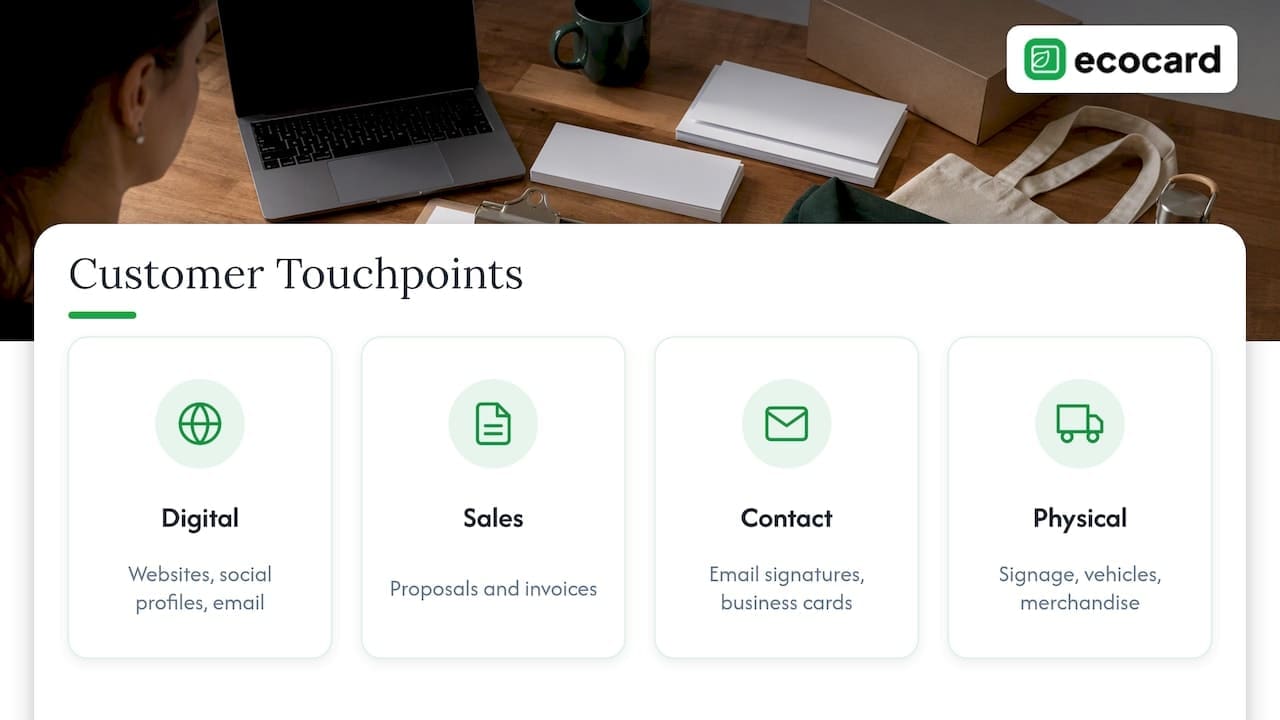
A team cannot keep consistent what it has not listed. Tiberius Digital suggests mapping every customer touchpoint, including websites, social profiles, email, proposals, invoices, email signatures, business cards, signage, vehicles and merchandise. Most teams cover the website and social media and forget the small items that individuals control themselves.
Business cards are a good example. Printed cards are ordered in batches, so a change of title or phone number means a reprint or a card that is wrong from the start. Staff leave with boxes of them. Different people also end up with slightly different layouts, especially across offices or when someone orders from a different supplier.
Perspective: where cards fit into brand governance
We built EcoCard around a simple observation: the details people share about your business are the details most likely to go out of date. A name, a role, a phone number, a link to a portfolio. Each is small, but together they are how a client remembers and reaches you.
Our approach is central management. A business admin sets the branding once, and every employee’s digital card follows it. When a role changes, the admin updates the card and it is live straight away. When someone leaves, their card is dealt with through the same central controls, rather than relying on a box of cards in a drawer. Our platform is designed so recipients do not need to install an app.
We think this belongs in your brand governance alongside the template folder and the cheat sheet. It is one more place where the rule is “one approved version, always current”. It also means fewer printed cards that go stale and get thrown out.
Chris
How one business card setup supports the rest of your brand
A digital business card is not a replacement for good guidelines. It is a way to apply them to something every staff member uses. With EcoCard for Business, our central admin management is designed to keep branding consistent across all employee cards, with onboarding and offboarding handled in one place. Features include QR code and direct-link sharing, NFC tap, multi-card management, live updating, portfolio and document sharing, and analytics on card usage.
If you are building out a full system for your team, these pages go deeper:
- A guide to employee digital business cards for NZ teams covers how to roll cards out across a business.
- Our offboarding checklist covers what to do with a person’s brand-facing details when they leave.
- Digital business card benefits for teams looks at analytics and privacy.
- QR banner design guidance helps with event material that links back to a card.
Audit on a schedule
Guidelines drift without checks. Hunt and Hawk recommends a full brand identity audit annually, with lighter quarterly check-ins on messaging consistency and customer perception. It suggests going to every six months during rapid growth, and auditing after major changes. BrandFolder gives similar guidance: a full audit each year with smaller regular checks.
These are practitioner recommendations, not rules. A reasonable rhythm for a small NZ team is a quarterly 30-minute spot check and a fuller annual review.
How to run it
- List the touchpoints. Use the list above: website, social, email signatures, proposals, invoices, cards, signage, vehicles.
- Sample each one. Brand Crafter suggests a cross-channel audit template covering your tagline format, voice attributes and visual rules, then spot-checking examples from each channel.
- Score them. Tiberius Digital scores each touchpoint from 1 to 5 for visual alignment, voice alignment, quality and accuracy, and treats anything under 3 as a priority fix.
- Mark them green, yellow or red. Brandlabs uses a green, yellow and red system. Every red item gets evidence, an owner and a due date.
- Fix, then update the guidelines. If the same mistake keeps appearing, the guideline or template is probably unclear.
A worked example
Imagine a 12-person consultancy in Wellington. A quarterly check finds three email signatures with an old logo (yellow), a proposal template in two versions (red), and two team members whose titles on their cards don’t match the website (red). The brand owner archives the old template, sends the cheat sheet again, and updates the people details. Next quarter the same spot check takes ten minutes. That is the whole point: small, regular, boring checks.
Get started this week
You do not need a rebrand to improve consistency. The Business Marketing Group’s guidance says local audiences value honesty over hype and substance over sizzle, and recommends auditing the current brand and aligning people through training and briefing. In a small team that translates into five actions:
- Put every approved asset in one shared folder and archive the rest.
- Write the one-page cheat sheet: voice, logo, colours, key messages.
- Name a brand owner and decide who approves exceptions.
- Add a 20-minute brand briefing to onboarding.
- Book your first quarterly check in the calendar.
Promo: keep staff cards on-brand without reprints
If your audit turns up mismatched titles, old logos on cards or reprints every time someone changes role, our platform is built for that. Individual plans are NZ$9.99 per month, and extra cards are NZ$4.99 per month. For teams, Starter is NZ$19.99 per month, Business is NZ$49.99 per month and Teams is NZ$99.99 per month. Enterprise has no published price. See EcoCard plans and pricing, or look at EcoCard for Business.
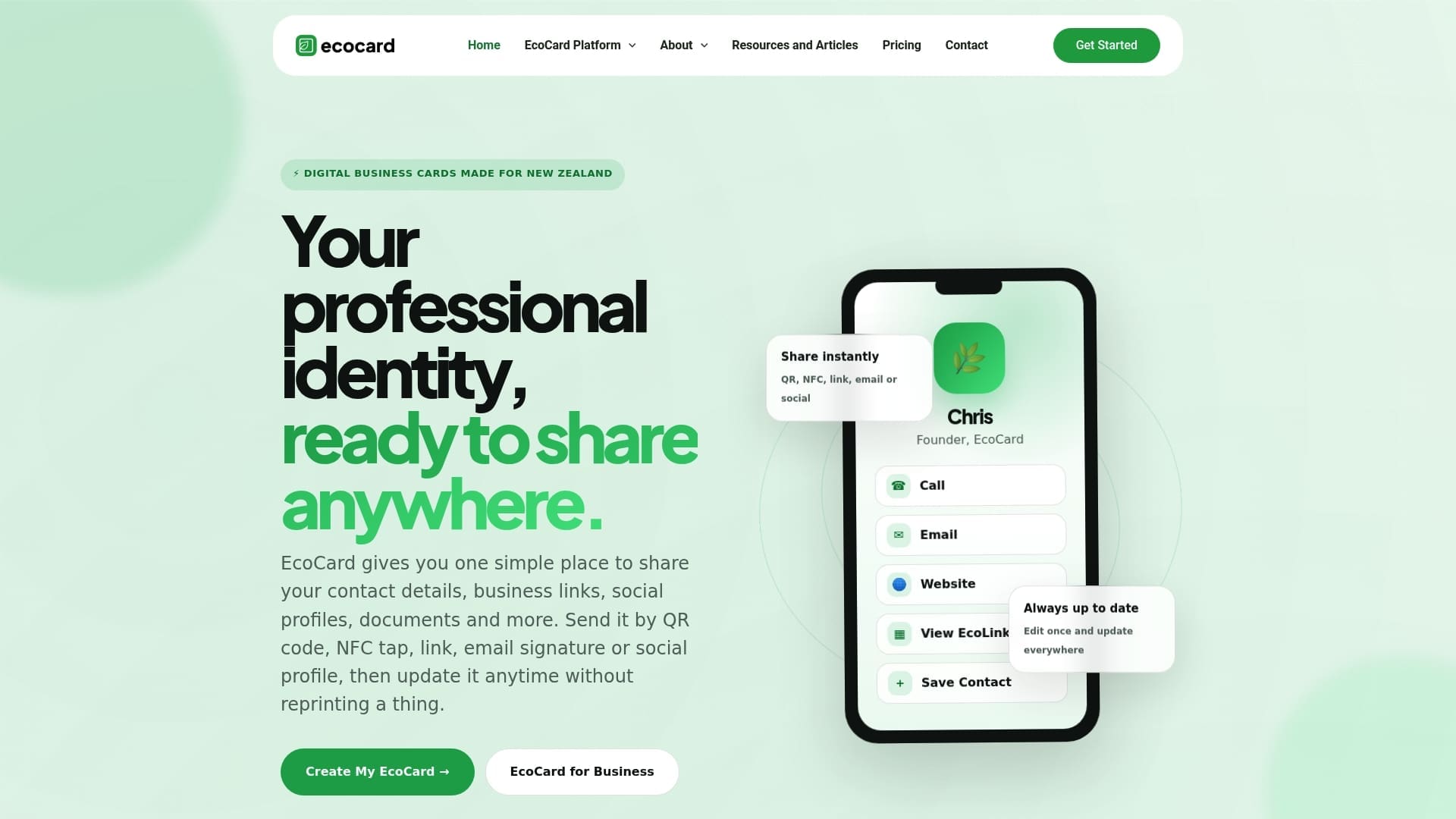
If you want to see what a branded card looks like first, our examples page shows how others have set theirs up.
FAQ
What is the quickest way to improve brand consistency in a small team?
Gather every approved asset into one clearly named shared folder, then write a one-page cheat sheet covering tone of voice, logo use, colour combinations and key messages. Both are simple systems recommended by Rosina Webb. Add them to onboarding so new people start with the right files.
What should a brand compliance checklist include?
It should cover guidelines with do’s and don’ts, an asset library, training, and a review and approval process. Add owners for each item and a check that advertising claims meet New Zealand law. The table earlier in this guide is a ready-made version you can copy.
How often should we audit our brand materials?
Practitioners suggest a full audit once a year, with lighter quarterly checks. Move to every six months if you are growing fast or have just changed your logo or direction. Give every problem an owner and a due date, or the audit won’t change anything.
Do business cards really affect brand consistency?
Yes. Cards carry your logo, your people’s names and titles, and their contact details, and individuals often control them. If those details differ from your website or go stale, customers notice. A centrally managed card, where an admin controls branding and updates, gives every person the same approved look and current details.
Sources
- Brand Consistency by Rosina Webb, Marketing New Zealand
- Brand expression: how to develop strong brand guidelines, NZTE
- New Kantar Corporate Reputation Index revealed, FMCG Business
- The Power of Consistency, George Design
- Why making a brand feel like itself is the real challenge, Creative Bloq
- Brand Voice Drift, FlyingToast
- Brand Consistency Across Channels, Tiberius Digital
- Brand Compliance, Shopify New Zealand
- Brand Governance Guide, IMPRNT
- Visual Identity Governance Guide, IMPRNT
- Brand Strategy Framework, Brand Crafter
- Brand guidelines: one doc to rule them all, Dave Clark Design
- Marketing Communications Code of Practice, Marketing Association
- eCommerce Store Legal Checklist for NZ, Sprintlaw NZ
- How to Run a Brand Identity Audit, Hunt and Hawk
- Brand Audits: A Comprehensive Primer, BrandFolder
- Brand Audit Checklist for Marketing Channels, Brandlabs
- Guide to brand positioning in New Zealand, The Business
Recommended
- Employee Digital Business Cards: A Guide for NZ Teams
- Avoid GST surprises: Digital business card pricing for NZ small teams
- One Tap, Live Updates: Digital Business Cards for NZ Teams
- How to Organise Business Contacts So You Can Find Them
This article was produced with AI assistance and reviewed for accuracy. It is provided for general information only and is not professional advice.

