


A single tracked checklist that assigns owners and sequences notification, knowledge transfer, IT and security work, and final pay is the fastest way to close an exit safely. Voluntary resignations give you a notice period to plan handovers; involuntary exits need the same steps compressed into hours, with access revocation happening first, not last.
TL;DR:
- Access revocation should occur immediately on the employee’s last day, not after, to prevent active sessions or API access remaining uncontrolled.
- Knowledge transfer needs to start as soon as departure is confirmed and be completed at least a week before the last day, utilizing recordings, SOPs, and shadowing.
- Final pay must be calculated and paid on or before the next scheduled payday, including wages, accrued leave, and any applicable notice pay.
- Updating external contact information and public team pages should happen simultaneously with internal offboarding steps to prevent outdated or unauthorized contact details.
- An accountable workflow assigns clear owners for each task, with verification, ensuring steps are completed in proper order, especially in compressed involuntary exit scenarios.
Table of Contents
- At-a-glance offboarding checklist the team can copy
- Timeline: day 0, notice period, last day and after departure
- Knowledge transfer: templates, recordings and shadowing that actually work
- IT and security checklist: revoke access, rotate shared secrets and verify
- Final pay, leave entitlements and record-keeping obligations
- Exit interviews and feedback: survey first, interview second
- Responsibility matrix: assign owners and verification steps
- Copyable checklist template (condensed and printable)
- A workflow that keeps every step accountable
- Keeping public contacts current when someone leaves
- Sources
- FAQ
At-a-glance offboarding checklist the team can copy
This is the shortlist to paste into your task system before you touch the detail below.
- Notification: confirm end date with the employee, then trigger the offboarding workflow (HR).
- Knowledge transfer: assign a successor and start documenting SOPs and open work (manager).
- Access: revoke logins, rotate shared passwords, and collect devices (IT).
- Pay: calculate final wages, leave payout and any notice pay (payroll).
- Records: archive contracts, performance notes and signed paperwork in the HR system, not a personal drive.
Keep signed documents and handover files in the same folder or HR platform every time, so an auditor or a new manager can find them without asking around.
Timeline: day 0, notice period, last day and after departure
The sequence matters more than the individual tasks. Miss the order and you either leak access or lose knowledge that walks out the door with the employee.
- Day 0: accept the resignation or document the termination decision, then trigger the offboarding workflow so HR, IT and payroll all get notified at once.
- During the notice period: the employee documents processes, hands off client relationships, and HR schedules the exit interview or survey for the final week.
- Last day: collect laptops and access cards, revoke system access, hold a short final meeting, and confirm payroll has the figures needed to run final pay.
- After departure: archive the employee’s files and correspondence, confirm final pay landed correctly, and run a short follow-up check with the team a few weeks later.
Voluntary exits let you spread these across weeks. Involuntary terminations compress steps one and three into the same hour, since access revocation and property collection typically happen immediately rather than on a scheduled last day, according to HR guidance on separating workflows by departure type.
Knowledge transfer: templates, recordings and shadowing that actually work
Good handovers cover four things: written SOPs for recurring tasks, a live project status list, a contact sheet for key clients and vendors, and a document showing where files and credentials live. Skip any one of these and the successor spends their first month reverse-engineering the role.

The formats that work best in practice are short screen recordings for repetitive digital tasks, written SOPs for anything with steps that must be followed exactly, and a longer walkthrough session of 90 to 120 minutes for the parts of the role that need explaining rather than reading. Where possible, schedule shadowing so the successor watches the departing employee do the work at least once.
Start this the moment the departure is confirmed and finish at least a week before the last day, which matches the handover timing recommended in departure checklist guidance. Name the successor early. An unassigned handover is a handover nobody owns.
IT and security checklist: revoke access, rotate shared secrets and verify
Disabling an account is not the same as ending access. A disabled login can still leave active sessions, browser tokens or API keys valid, so the checklist needs to go further than flipping a switch.
- Accounts and tokens: revoke SSO, email, cloud storage, VPN and API access, and close out any linked social accounts used for the role.
- Shared credentials: rotate any shared passwords the departing employee had access to, not just their personal logins.
- Sessions: force logout on all active sessions rather than relying on a disabled account to expire them on its own.
- Devices: retire or wipe through your device management tool, or issue clear return instructions with a chain-of-custody record for anything collected in person.
Pro tip: Attach screenshots or system logs showing each account disabled to the offboarding ticket. It turns a checklist into an audit trail.
Update the company’s team page and any published contact details at the same time you revoke internal access, since a leaver’s name and number sitting on a public page is its own kind of exposure.
Final pay, leave entitlements and record-keeping obligations
Final pay commonly includes wages up to the last day worked, any outstanding annual leave, notice pay where it applies, and reimbursement of legitimate expenses. Getting the timing and the paperwork wrong is one of the most common sources of post-exit disputes.
- Wages and leave: calculate pay to the exact last day, plus accrued and unused annual leave.
- Timing: final pay must be paid on or before the next scheduled payday, and employers must keep payroll and holiday records to support that calculation.
- Retention: hold onto payroll and HR records for the period your jurisdiction’s employment law requires, and keep them accessible in case of a later query.
- Disputes: Employment New Zealand sets out how employees can raise concerns if they believe their final pay is wrong, so point departing staff to that process rather than handling disputes informally.
Final pay paid on or before the next scheduled payday is the standard employers are expected to meet, according to Employment New Zealand’s guidance on final pay. That single deadline drives most of the payroll sequencing above.
Exit interviews and feedback: survey first, interview second
Employees are more candid in writing than in a room with their manager present. Send an anonymous exit survey before offering a voluntary interview, and let the employee choose whether to add a conversation on top.
- Reason for leaving: ask directly, without framing it as a chance to change their mind.
- Role and manager feedback: separate questions about the job itself from questions about their manager.
- Process improvements: ask what they’d fix about how the team or company operates.
Pro tip: Run the exit survey through HR or a neutral third party rather than the departing employee’s direct manager. It’s the sequence that produces more candid feedback, not the questions alone.
Route the answers to whoever owns retention decisions, not just into a file. Feedback that never reaches a decision maker doesn’t improve anything.
Responsibility matrix: assign owners and verification steps
Every task needs one owner and one way to confirm it’s done. Without both, offboarding tasks either double up or get missed entirely, especially in a small team where one person wears several hats.
- HR: confirms the end date, runs the exit interview, and verifies the personnel file is complete before archiving it.
- Manager: owns knowledge transfer and confirms the successor has what they need before the last day.
- IT: revokes access and confirms with a logged screenshot that every account is closed.
- Payroll: calculates and confirms final pay against the leave balance on record.
In a one-person HR function, the same person often runs all four roles in sequence rather than in parallel, so build extra time into the timeline rather than skipping the verification step.
Copyable checklist template (condensed and printable)
Copy this into a spreadsheet or task tool and add owner, due date and a verification tick box to each line.
- Confirm end date and reason for departure (HR, day 0).
- Trigger offboarding workflow across HR, IT and payroll (HR, day 0).
- Notify manager and assign a successor (manager, day 0).
- Begin knowledge transfer documentation (employee and manager, during notice).
- Schedule exit survey and optional interview (HR, final week).
- Notify remaining team and relevant clients of the departure (manager, final week).
- Collect devices and physical assets (IT and facilities, last day).
- Revoke system access and rotate shared credentials (IT, last day).
- Update org charts, directories and any published team listings (HR or admin, last day).
- Run final meeting and confirm return of company property (manager, last day).
- Calculate and process final pay (payroll, by next scheduled payday).
- Archive personnel file and handover documents (HR, post-departure).
- Offer a reference letter or transition support where appropriate (HR or manager, post-departure).
- Confirm final pay landed and close the offboarding ticket (HR, post-departure).
Store signed paperwork and handover files in the HR system rather than a personal drive, so the next person doesn’t start from zero.
A workflow that keeps every step accountable
The workflow that holds up under pressure is simple: HR triggers the process, IT deprovisions access on a fixed schedule, and the manager runs the handover in parallel rather than waiting for IT to finish first. Where teams publish contact details externally, keeping those pages current with a tool like EcoCard closes a gap most checklists miss.
— Chris
Keeping public contacts current when someone leaves
Most offboarding checklists stop at internal systems and forget the public-facing side: a team page, a shared contact list, a printed card still sitting in someone’s wallet. EcoCard’s central admin management lets a business update or deactivate a departing employee’s card from one place, so their details stop circulating the moment they leave rather than weeks later.
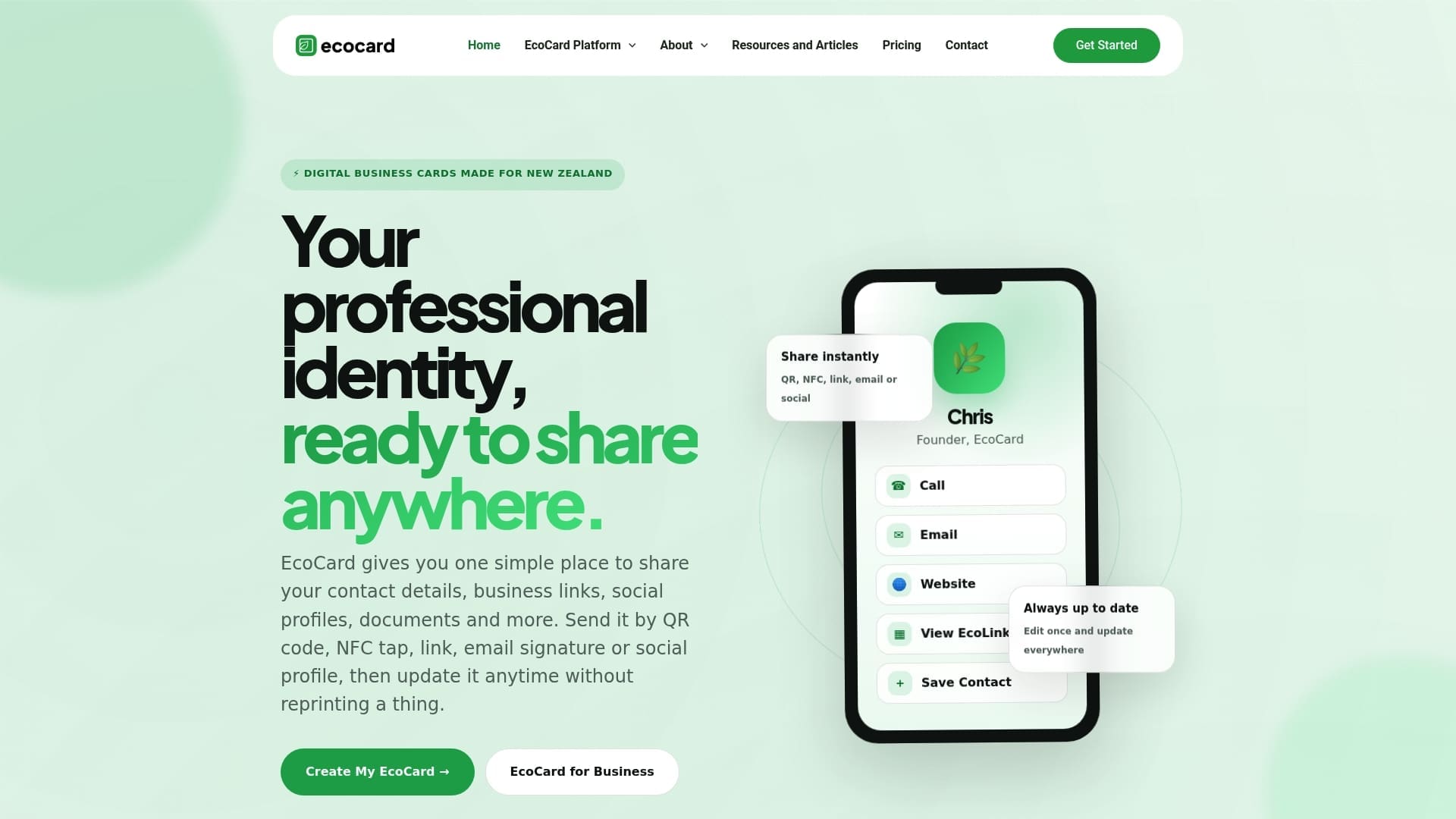
Because updates apply live across every card issued under a business account, there’s no reprinting and no chasing down old cards to physically destroy. Plans range from an Individual card at $9.99 NZD per month to Business at $49.99 NZD per month and Teams at $99.99 NZD per month for larger groups managing multiple staff cards centrally. If your offboarding checklist currently includes “collect old business cards” as a manual step, it’s worth checking EcoCard’s pricing to see whether that step can disappear entirely.
Sources
The payroll and timing points above draw on Employment New Zealand’s guidance on final pay and its guidance on employer obligations after the last day of employment, covering record retention and property return. For handover formats and timing, Employment Hero’s departure checklist sets out practical templates. Businesses managing employment administration alongside offboarding can also look at how an employer of record handles compliant hiring workflows for comparison.
FAQ
What is an employee exit checklist?
An employee exit checklist is a structured list of tasks covering notification, knowledge transfer, IT access revocation and final pay, each assigned to an owner with a deadline. It exists to stop any single step, like revoking access or paying out leave, from being missed during a departure.
What are the best practices for offboarding employees?
Best practice means starting knowledge transfer as soon as a departure is confirmed, revoking system access on the last day rather than after, and paying final wages and leave by the next scheduled payday. Running an anonymous exit survey before any interview also tends to produce more honest feedback.
What are the steps in the employee offboarding procedure?
The core sequence is: confirm the end date and trigger the workflow, transfer knowledge during the notice period, collect devices and revoke access on the last day, then process final pay and archive records afterwards. Employment New Zealand also expects employers to update and retain payroll records through this process.
Is offboarding the same as firing someone?
No. Offboarding is the full process of closing out any employee’s departure, whether they resigned, retired or were terminated, while firing refers only to an involuntary termination. The tasks overlap , but involuntary exits usually compress the timeline, particularly around access revocation.
When must final pay be paid after someone leaves?
Final pay must be paid on or before the employee’s next scheduled payday, and it should include outstanding wages and holiday pay. Employers are expected to keep payroll records to support that calculation and to explain the process if an employee raises a concern.
This article was produced with AI assistance and reviewed for accuracy. It is provided for general information only and is not professional advice.

