


The best networking follow-up is a short message sent within the same day when you discussed a specific opportunity, or by the next business morning for a casual introduction. Keep it under 150 words, lead with email or LinkedIn, and structure it around one clear reference, one small offer of value and one easy next step.
TL;DR:
- Sending a follow-up within the same day for concrete opportunities or by the next business morning for casual introductions significantly increases the likelihood of continued engagement.
- Keep follow-up messages concise, structured around a reference to the conversation, a small offer of value, and a simple next step, ideally under 150 words.
- Use different channels appropriately: email for detailed information, LinkedIn for quick connections, and voice notes for personalized post-event follow-ups, switching channels if responses stall.
- Tracking outcomes and promises immediately after conversations helps maintain relationships and ensures follow-through on next steps.
- Digital business cards that update live and share via QR or NFC reduce contact detail errors and simplify the follow-up process at events.
Table of Contents
- Why fast, specific follow-up turns introductions into relationships
- When to follow up: clear timing rules for different scenarios
- What to say: a concise message structure and copy-ready templates
- Channels and quick-format follow-ups: email, LinkedIn, voice notes and when to use them
- Turning follow-ups into next steps and tracking them properly
- Maintaining relationships: simple cadence and value drops
- How digital business cards reduce friction in follow-up
- Post-event routines that actually stick
- A short, honest alternative: try a digital card to make follow-up easier
- Sources
- FAQ
Why fast, specific follow-up turns introductions into relationships
A follow-up message does more than close a loop. It signals that you paid attention, and attention is memorable in a room full of people swapping cards and small talk. Research on network formation finds that time of exposure and prior acquaintance strongly predict whether a professional relationship forms and lasts, often more reliably than simple trust signals exchanged in the first conversation. A follow-up message is, in effect, a second exposure. It extends the window in which a stranger becomes a contact.
Prior acquaintance and timely follow-up are stronger predictors of a lasting professional tie than first-meeting charm, according to network formation research. That is useful news if you left an event feeling you didn’t make the strongest first impression: a well-timed, specific follow-up can still do the work.
When to follow up: clear timing rules for different scenarios
Timing matters more than polish. A message sent quickly, even a plain one, tends to beat a polished message sent a week late.
- Send a follow-up message within the same day when you discussed a concrete next step, a job opening or a live opportunity, as intent is high and the window closes quickly.
- Send by the next business morning for a casual event introduction or a general “let’s stay in touch” exchange.
- Allow 48 to 72 hours for anything asynchronous, such as sending a document someone asked for.
- After two unanswered messages on the same channel, switch channels rather than sending a third identical note.
This timing split matches general email etiquette guidance, which treats same-day response as the norm for anything with a specific ask attached, and next-morning as acceptable for lower-stakes contact.
Pro Tip: Draft your follow-up the same evening while details are fresh, then schedule it to land around 8 to 9am the next business day so it’s timely without looking rushed.

What to say: a concise message structure and copy-ready templates
The most reliable structure for a networking follow up is Reference, Value, Ask. You remind the person what you discussed, offer something small and useful, then ask for one easy next step. Concise, Reference–Value–Ask follow-ups under roughly 150 words consistently outperform longer, unfocused ones, and the structure is field-tested precisely because it respects a busy reader’s time.
- Reference: one sentence naming the event, the topic you discussed, or a detail that only someone who was actually there would mention.
- Value: one small offer, an article, an introduction, a resource, or a direct answer to something they mentioned needing.
- Ask: one low-friction next step, a short call, a coffee, or simply “happy to stay in touch if useful.”
Subject lines carry a lot of the opening work. A generic “Following up” gets ignored; a subject that references the event or a specific detail jogs memory and earns the open. Try patterns like “Great chatting at [event] about [topic]” or “Following up on [specific detail] from Tuesday.”
A few templates to adapt:
- Brief thank-you: “Hi [name], great meeting you at [event] and hearing about [topic]. Wanted to say thanks for the chat and wish you well with [specific project]. Happy to stay in touch.”
- High-intent recap with proposed next step: “Hi [name], following up on our chat about [specific opportunity]. As discussed, I’d love to set up 15 minutes this week to talk through [detail]. Does Thursday morning work?”
- Intro request: “Hi [name], enjoyed talking [topic] at [event]. You mentioned [contact] might be a good person to speak with about [reason]. Would you be comfortable making an introduction, or happy to send a short blurb you can forward?”
- Post-conference voice note plus email: a 30-second voice note saying “Hey, it’s [name] from [event], loved the [specific] chat, sending a quick note with the resource I mentioned,” paired with a short email carrying the actual resource and one line restating the ask.
Channels and quick-format follow-ups: email, LinkedIn, voice notes and when to use them
Choose the channel to match the content, not the habit.
- Email suits detailed recaps, attachments and anything you want the person to find again later.
- LinkedIn suits a quick connection request with a one-line note referencing where you met, useful when you don’t have an email address yet.
- A voice note or short Loom works well after conferences, where a bit of personality helps you stand out among dozens of new contacts.
Micro-scripts for each: email, “Great meeting you at [event], sending the [resource] we discussed, keen to reconnect soon.” LinkedIn, “Hi [name], enjoyed our chat at [event] about [topic], would love to stay connected.” Voice note, “Hey [name], it’s [you] from [event], that point about [topic] stuck with me, sending a follow-up email now.”
If two attempts on one channel go unanswered, switch rather than repeat. A polite LinkedIn note referencing the earlier email (“just following up on the note I sent last week, in case it landed in spam”) reads as considerate rather than pushy.
Turning follow-ups into next steps and tracking them properly
A follow-up that doesn’t propose a next step tends to die quietly. Make the ask small enough to accept without thinking.
- Propose one low-friction step, a 15-minute call or a specific introduction, and suggest a concrete time: “Would Wednesday at 2pm work for a quick call?”
- Write recaps so they’re easy to forward: a one-line summary followed by three bullet points survives being pasted into someone else’s inbox intact, which matters because a short, forwardable recap increases the chance of an internal introduction.
- Record the outcome and anything you promised in your CRM or a simple notes file the moment the conversation ends, before the details blur into the next meeting.
A basic spreadsheet or a lightweight CRM works fine for this. The point isn’t the tool, it’s the habit of writing down what you owe someone before you forget.
Maintaining relationships: simple cadence and value drops
Staying visible without becoming a nuisance comes down to cadence and content. Warm contacts, people you’ve met and spoken with meaningfully, are worth a touch roughly every three months. Cooler or cold leads can sit at six to twelve months between check-ins without the relationship going stale.
- Share a curated article relevant to their work or industry.
- Offer a short introduction to someone useful in your network.
- Flag a relevant event or invite them to one.
- Pass along a market insight they wouldn’t otherwise see.
Pro Tip: Keep a short tag or note against each contact so you never repeat the same offer twice or forget the context of your last conversation.
How digital business cards reduce friction in follow-up
A surprising number of follow-ups fail simply because the phone number or email on the card someone handed you was already out of date. Live-updating digital cards solve that specific problem: details change once and update everywhere instantly, so a follow-up message never bounces off a dead email address. QR codes, NFC taps and shareable links also mean a contact’s details land straight in your phone at the event, with no typing errors and no lost paper card. EcoCard, for instance, includes an EcoWallet feature so saved contacts are easy to find again when it’s time to follow up, and its central admin tools let a business keep branding consistent across a whole team, including onboarding and offboarding staff cards without chasing anyone down.

Post-event routines that actually stick
The habit that matters most is capturing detail while it’s still fresh: a quick note on the back of a card, or in your phone, the moment a conversation ends. From there, a simple three-step routine works: jot the detail, draft the follow-up that evening, schedule it to send the next morning. One contact I nearly let slip after a slow week turned into a client referral eight months later, purely because a two-line note in my contacts app reminded me what we’d actually discussed.
— Chris
A short, honest alternative: try a digital card to make follow-up easier
Good timing and a tight message structure solve most of the follow-up problem, but the exchange at the start still matters. A misspelled email or a dead phone number undoes all of that good work before it starts. EcoCard removes that friction point by giving you a digital card that updates live, shares by QR code, NFC tap or direct link, and keeps every contact organised in one place.
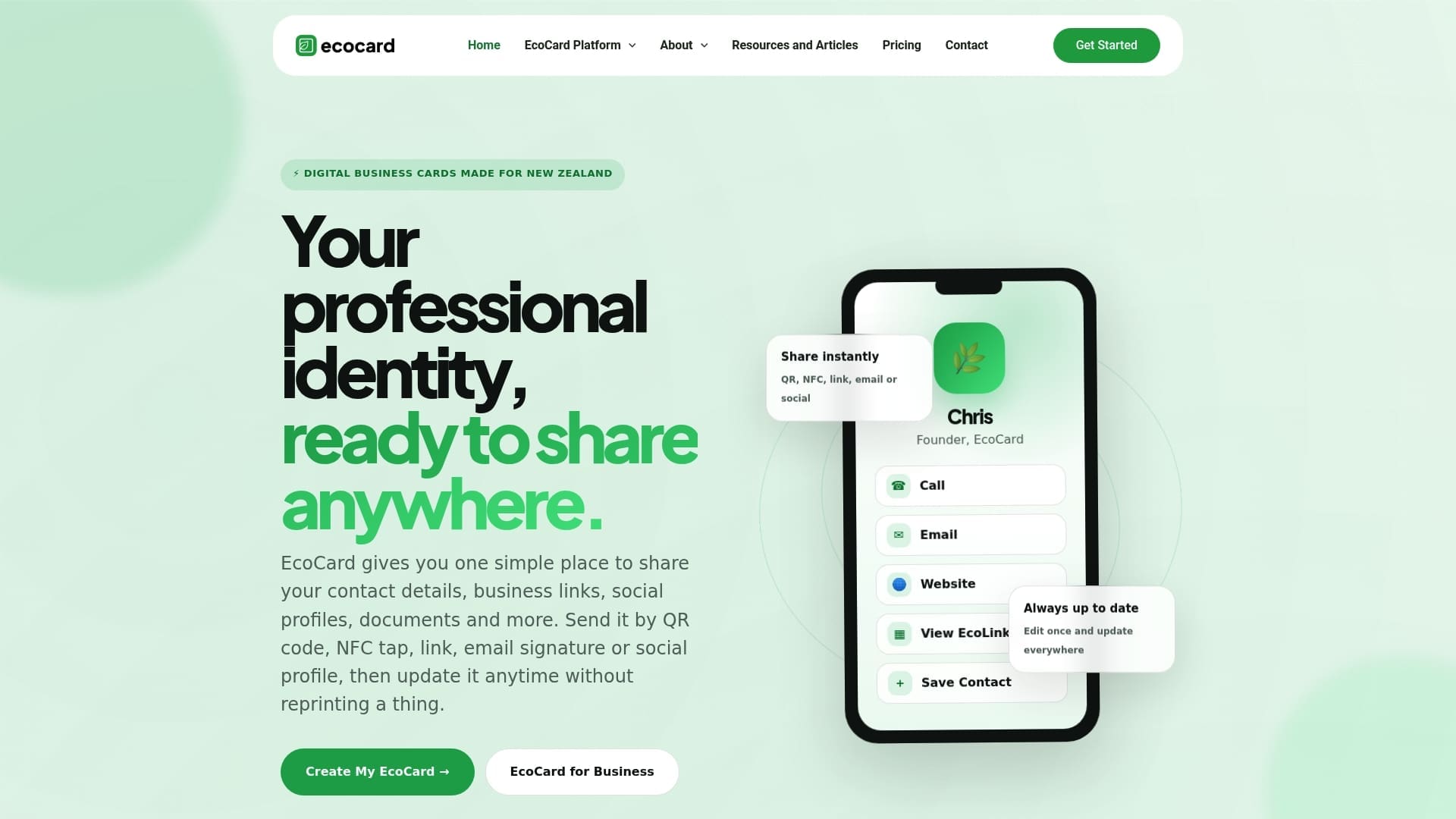
- Live updates, so a contact never has outdated details to follow up on.
- QR and NFC sharing, which speeds up the exchange at busy events.
- Multiple cards and roles, useful if you represent more than one business or project.
- Central admin for teams, keeping branding consistent across everyone’s card.
If you want to see how it works before committing, the Individual EcoCard plan costs $9.99 NZD per month, or browse the full range on the pricing page.
Sources
For the research and practical guidance behind this article, see trust and network formation research, general email etiquette guidance, and templates for follow-up emails after meetings. For general tips on tech tools for scheduling and reminders, see OK Technology.
- Follow-up email after meeting: templates and examples (HubSpot blog)
- Trust and the dynamics of network formation (Network Science, Cambridge Core)
FAQ
How to follow up when networking?
Send a short message within the same day if you discussed a specific opportunity, or by the next business morning for a casual introduction. Use the Reference, Value, Ask structure and keep it under 150 words for the best chance of a reply.
What to say in a follow-up email after a networking event?
Reference a specific detail from your conversation, offer one small piece of value such as an article or introduction, then ask for one easy next step like a short call. This Reference–Value–Ask structure keeps the message short and easy to act on.
When should you send a follow-up note after a networking event?
Same day works best when a concrete next step or opportunity was discussed, while the next business morning is fine for general introductions, according to common email etiquette guidance. Waiting longer than a few days lets the memory of your conversation fade.
What is a good subject line for networking emails?
A good subject line references the event or a specific detail from your conversation rather than a generic phrase like “following up.” Something like “Great chatting at [event] about [topic]” jogs memory and tends to get opened faster than a vague one.
Recommended
This article was produced with AI assistance and reviewed for accuracy. It is provided for general information only and is not professional advice.

