


No, business cards are not dead, but they no longer do the whole job on their own. Paper still makes a meeting memorable and gives people something to hold. The weak point is that a printed card can’t be updated, can’t be searched and often ends up in a drawer. The sensible approach for most New Zealand professionals is a card that works in the room and a digital profile that works after it.
TL;DR
- Paper cards still have a place at in-person events, interviews and unplanned meetings, and some people simply prefer them.
- Their weaknesses are practical: details go stale, there is no follow-up trail, and a card only helps if the person keeps it.
- A digital business card fixes those gaps with live updates, a QR code or tap, and no app for the person receiving it.
- Most people do best with both: a simple paper card or QR-printed card for the handshake, a digital profile as the source of truth.
- Teams gain the most from digital, because branding and contact details can be managed in one place.
Table of Contents
- Why the “dead” question keeps coming up
- What paper business cards still do well
- Where paper cards fall short
- Digital business cards: what changes
- Digital vs paper: a side-by-side view
- What about the environmental argument?
- So, do you still need business cards?
- The future of business cards
- Why teams benefit most from going digital
- Our perspective
- Try a digital card alongside your paper ones
- FAQ
- Sources
Why the “dead” question keeps coming up
Every few years someone declares the business card finished. Phones hold our contacts, LinkedIn holds our work history, and a QR code can pass on a link in seconds. Reasonable people conclude that a rectangle of card is redundant.
The evidence is more mixed. In an informal survey of 61 of his LinkedIn contacts, a University of Auckland-linked academic writing in The Conversation found that more than half used both business cards and LinkedIn for introductions, while others used cards only or neither. It is a small sample, and he presents it as informal, but it matches what many of us see at events: the card has not vanished, it has been joined by other tools.
So the better question is not whether cards are dead. It is what a card is for, and which format does that job best in a given situation.
What paper business cards still do well
The same article argues that cards still convey a personal brand, make a meeting memorable and give a quick way to swap details. Three situations show it most clearly.
Face-to-face moments with no setup
HEC Montréal’s careers service advises using cards at networking and recruitment events, at speed interviews and in unforeseen situations where you need to present yourself. It also suggests considering electronic cards while keeping physical ones on hand, because some people prefer them. That last point matters. You don’t get to choose how the other person wants to receive your details.
Moments that need to feel personal
Adobe’s 2024 analysis reports that 70% of respondents found exchanging a paper card more meaningful than connecting on LinkedIn, and 61% said paper cards make it easier to remember details about someone. This is a design-software company’s own research, so treat the figures as a signal rather than a verdict. The direction is plausible, though: a physical object tied to a face is a memory aid.
The tactile argument isn’t only about nostalgia. When you hand over a card you also create a small pause in which names and roles get repeated. That pause is useful whether the card is paper or a phone screen showing a QR code.
Meetings where in-person still matters
Event platform Brella analysed data from 10,000 events between 2016 and 2021 and found that in-person attendees were 21% more likely to accept one-to-one meetings than virtual attendees. In New Zealand, where trust and relationships drive a great deal of business, that matters. A 2026 look at the NZ and Australian events sector found that 56% of event professionals saw a stronger desire for connection as the biggest shift in attendee behaviour. People are still turning up to meet each other, and they need a way to stay in touch afterwards.
There is also a cultural point if you deal with overseas clients. In parts of Asia, Latin America and Southern Europe, exchanging cards is still a professional ritual, and ignoring it can sour an exchange. If you export or host visitors, carry something to hand over.
Where paper cards fall short
The case against paper is not that cards are old. It is that they behave badly after the handshake.
- They go out of date. A new role, mobile number or website means a reprint, and every card already handed out is wrong.
- They hold very little. A card fits a name, a few contact lines and perhaps a QR code. It can’t carry a portfolio, a booking link or a case study.
- Follow-up is manual. Someone has to type the details into a phone. Many never do.
- You can’t see what happened. You don’t know whether the card was kept, scanned or binned.
- Teams struggle to keep them consistent. When ten people order cards at different times from different printers, logos, titles and wording drift.
The often-quoted line that most cards are thrown away within a week comes from an opinion piece rather than a study, so we wouldn’t build a plan on it. But the underlying problem is real and easy to recognise from your own drawer.
Digital business cards: what changes
A digital business card is a profile page with your details, links and documents, shared by QR code, a link or an NFC tap. The person receiving it opens it in their phone browser, so there is nothing to install. You change the profile once and everyone who opens it sees the current version.
In practice that gives you:
- Live details. A promotion or phone number change takes a minute, not a print run.
- Richer content. Social profiles, a portfolio, documents and booking links sit behind one scan.
- Quick saving. The contact can be saved straight to a phone rather than retyped.
- Multiple roles. Consultants who wear several hats can keep separate cards for each.
- Usage insight. Some platforms show how often a card is opened, which helps with follow-up.
None of this makes digital strictly better. It makes it better at the parts of networking that happen after the meeting. For the practical detail of getting set up, our guide to creating a secure, live digital business card walks through QR, link and vCard options.
A note on NFC and QR
Tap-to-share is neat, but it depends on the other person’s phone and settings. That is why a QR code should always sit next to it. We explain the trade-offs in why QR still matters when NFC taps fail, and cover the safety questions in are NFC business cards safe.
Digital vs paper: a side-by-side view
| Question | Paper card | Digital card |
|---|---|---|
| Works with no phone or battery | Yes | No |
| Memorable in the hand | Strong | Depends on how you present it |
| Easy to update | No, needs a reprint | Yes, instantly |
| Space for portfolio and links | Very limited | Plenty |
| Recipient needs an app | No | No, opens in a browser |
| Saves into contacts quickly | Manual typing | One tap or scan |
| Shows whether it was used | No | Can, with analytics |
| Consistent across a team | Hard | Easy with central management |
| Preferred by some older or traditional contacts | Often | Sometimes |
Paper wins on simplicity and presence. Digital wins on accuracy, depth and follow-up. That is why “either or” is the wrong frame.
What about the environmental argument?
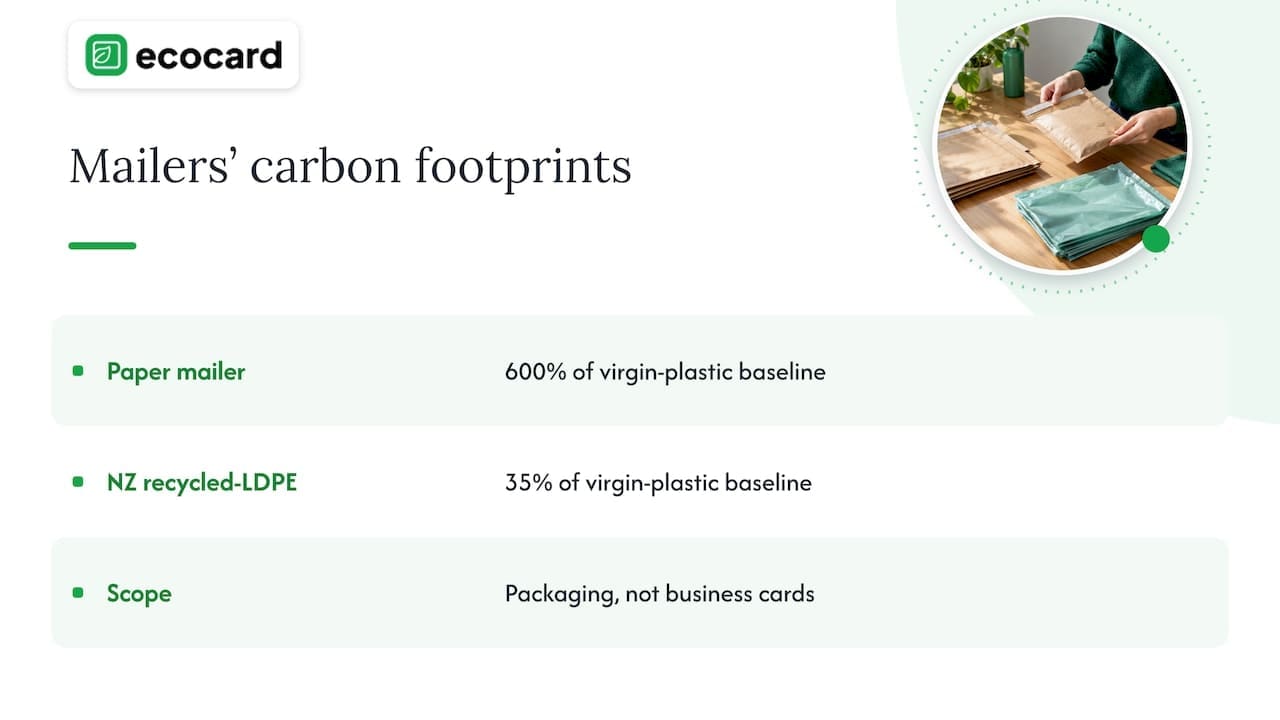
Reducing waste is a common reason to go digital, but be careful with sweeping claims. NZ Post’s life-cycle work on mailers shows that material choice and end-of-life change the result a lot: a paper mailer came out at 600% of the carbon footprint of a virgin-plastic baseline, while a New Zealand-made recycled-LDPE mailer came out at 35%. That is packaging, not business cards, but it is a good reminder that paper is not automatically the low-footprint option.
Closer to our topic, the Life Cycle Association of New Zealand reports a thinkstep-anz comparison in which an electronic greeting card had a much lower carbon footprint than a paper card. The paper card’s main hotspot was transport, and the e-card’s was electricity. The organisation notes that Aotearoa’s grid is mostly renewable, which helps the digital case. It compared greeting cards, not business cards, so read it as a pointer, not proof. You can see how we think about this on our environmental impact page.
So, do you still need business cards?
It depends on how you meet people.
You probably want paper if
- You regularly attend trade shows, conferences or in-person networking.
- You work with clients or partners from cultures where card exchange is customary.
- You are job hunting and might meet someone unexpectedly.
- Your customers are less comfortable with QR codes or phones.
You can lean digital if
- Most of your introductions happen by email, video call, LinkedIn or text.
- Your role, location or services change often.
- You are a consultant with several offers or a portfolio to show.
- You run a team and need consistent details across every person.
The hybrid most people end up with
Carry a small stack of simple paper cards or one card with a QR code. Make the QR code point to your live digital profile, so the paper never goes out of date in the way that matters. Our guide to making QR code business cards print ready covers the minimum size and layout so it scans reliably.
This also fits how New Zealanders actually network. We tend to meet in person, then keep the relationship going through email and LinkedIn. Our piece on contactless networking in NZ goes into the tap, scan and follow-up routine in more detail.
The future of business cards
The likeliest future is not a graveyard. It is a split of jobs. The physical card becomes a prompt, a keepsake or a courtesy, often with a QR code on it. The digital profile becomes the place where the real information lives, and where you look after your professional identity. Our article on building a digital identity for professionals shows how the pieces fit together.
What won’t change is the reason people network. As one NZ career writer puts it, a few high-quality connections often matter more than broad, shallow ones. Whatever format you use, the card is only the start of the conversation.
Why teams benefit most from going digital
For an individual, a stale paper card is a nuisance. For a business, it is a branding and admin problem. Staff join, change roles and leave. Each change means new cards, and old cards keep circulating with people’s former titles on them.
With a centrally managed digital card system, an administrator can:
- Set the template once so every card carries the same logo, colours and layout.
- Onboard a new starter with a ready-made card on day one.
- Update a title or phone number without a reprint.
- Deactivate a leaver’s card so their details stop being shared under your brand.
- Add shared documents or portfolio links that every team member can show.
If you manage staff, our guide to employee digital business cards for NZ teams goes through the process, and the benefits for teams article covers analytics and privacy. If privacy is your first question, read what NZ professionals should check before you choose a provider.
Our perspective
We built EcoCard because we think the debate is framed the wrong way. The card was never the point. The point is that someone you met can find you, trust you and get in touch, with details that are correct on the day they look.
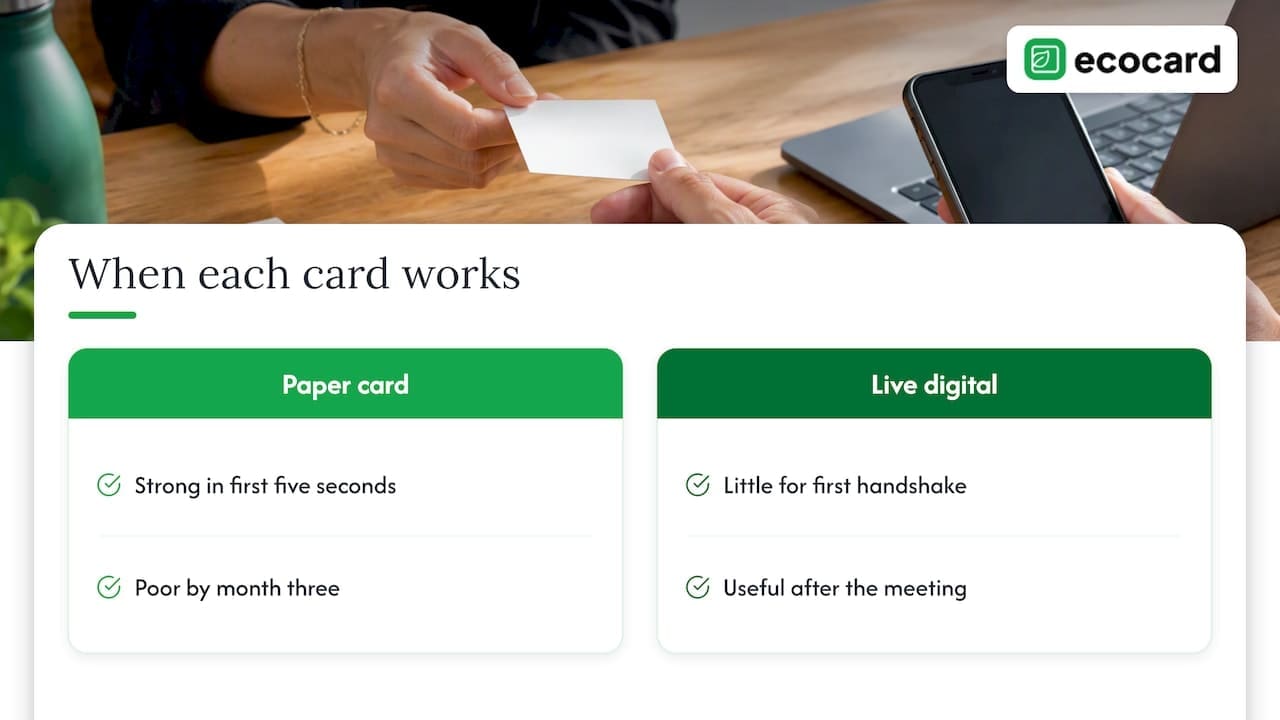
Paper is good at the first five seconds. It is poor at month three, when your title has changed or the contact needs your latest case study. A live digital card is the reverse: it does little for the first handshake but a great deal for everything after it.
So we don’t tell people to throw their paper cards away. We tell them to stop relying on paper for information that changes. Put your details in one place you control, share them by QR code, link or tap, and let a printed card, if you still use one, point to that page.
For businesses, the bigger win is control. One admin view, consistent branding and a clean offboarding process remove the quiet mess of old cards in circulation. Recipients don’t need to install anything, which keeps the exchange as easy as handing over a card.
— Chris
Try a digital card alongside your paper ones
EcoCard gives you a branded digital card you can share by QR code, link or NFC tap, with live updates, multiple cards and roles, portfolio and document sharing, and the EcoWallet for saving contacts. Plans are billed monthly:
- Individual: NZ$9.99 per month
- Additional EcoCards: NZ$4.99 per month
- Starter: NZ$19.99 per month
- Business: NZ$49.99 per month
- Teams: NZ$99.99 per month
- Enterprise: pricing on request
See the full plan details to pick the right size, or start with the individual EcoCard if you just want to try it next to your current cards. Teams can look at EcoCard for Business.
FAQ
Are business cards still relevant?
Yes, in the right situations. They work well at events, interviews and chance meetings, and some people still prefer to receive one. They are weakest when information changes often or when you need follow-up, which is where a digital profile helps.
Is a digital business card better than paper?
It is better at staying current, holding portfolios and links, and speeding up saving a contact. Paper is better when a phone isn’t to hand or the moment calls for something tangible. Most professionals get the best result from using both.
Do people need an app to receive a digital card?
Not with EcoCard. The recipient scans a QR code, taps or opens a link, and the card loads in their browser. That keeps the exchange as simple as accepting a paper card.
What should I put on a paper card if I also have a digital one?
Keep it short: your name, role, one main way to reach you and a QR code to your live profile. Leave out anything likely to change, such as a long list of services. The digital card can carry those, and you can edit it any time.
Should my business switch all staff cards to digital?
For most teams it is worth it, because central control keeps branding consistent and makes onboarding and offboarding simple. Staff who regularly attend in-person events may still want a basic printed card with a QR code linking to their digital one.
Sources
- Despite appearances, digital networking hasn’t killed the business card yet, The Conversation
- Don’t underestimate the importance of business cards, HEC Montréal
- What makes a business card work? Adobe
- Top Event Networking Trends, Brella
- The Future of Business Events: 2030 and Beyond
- Why business cards still matter, BBC Worklife
- Sustainable packaging, NZ Post
- Spreading sustainable Christmas cheer: paper cards or e-cards, LCANZ
- Your network is becoming the most valuable asset you have, Liz Barry
Recommended
- Digital Business Card Privacy: What NZ Professionals Should Check
- One Tap, Live Updates: Digital Business Cards for NZ Teams
- Avoid 4 Print Mistakes When Adding LinkedIn to NZ Business Cards
- Digital Identity for Professionals: Build One That Works
This article was produced with AI assistance and reviewed for accuracy. It is provided for general information only and is not professional advice.

