


Most digital business card platforms charge per user or per business tenant, with individual plans typically costing less than ten New Zealand dollars a month and team or business tiers generally ranging from twenty to one hundred New Zealand dollars a month depending on headcount and admin features. Enterprise pricing is usually custom. Before you sign up, confirm the billing cadence, what central admin controls are included, and how GST appears on your invoice.
TL;DR:
- Most plans cost less than $50 a month for small teams, with enterprise pricing tailored to high headcount and support needs.
- Annual billing often includes discounts but requires confirmation, as it is rarely advertised alongside monthly prices.
- Central management features like bulk onboarding, instant offboarding, and role-based permissions significantly save administrative time and improve security.
- For New Zealand businesses, GST at 15 percent applies when purchasing from local providers or marketplaces, with proper invoice documentation necessary for claims.
- Picking the right plan depends on your team size, branding needs, onboarding frequency, and required integrations, so ask vendors detailed questions upfront.
Table of Contents
- Pricing models and typical price ranges
- Feature tiers: what features usually appear at each price level
- Budgeting and GST: what New Zealand businesses must check
- How to pick the right plan for your business or team
- Why central management changes the value calculation
- A straightforward way to manage your team’s cards
- FAQ
- Sources
Pricing models and typical price ranges
Three pricing structures dominate this category. Per-user (seat) pricing charges a set amount for each person with a card, which scales predictably as your team grows. Per-tenant or flat plans charge one price for the whole business regardless of headcount, which suits smaller teams that do not expect to grow quickly. Tiered feature bundles sit alongside either model, where paying more unlocks analytics, branding controls or integrations rather than more seats.
For individuals, pricing is typically low, often under $10 a month for a single professional card with basic sharing features. Small team or starter tiers tend to sit in the $20 to $50 a month range, usually covering a handful of users plus some central management. Business and larger team tiers climb toward $50 to $100 a month, adding deeper admin controls and analytics. Enterprise pricing almost always moves to a custom quote, since it depends on headcount, integrations and support needs.

Billing cadence changes the effective cost. Paying annually instead of monthly commonly brings a noticeable discount off the monthly rate, which is worth asking about directly since it is rarely advertised prominently. A partner pricing page from a different SaaS category shows how common this tiered, cadence-based structure is across subscription software generally, not just digital cards.
Watch for these common add-ons before you commit to a plan:
- Extra cards for team members beyond your base plan’s included seats.
- White-labelling or custom branding beyond the default templates.
- Priority onboarding or dedicated setup support for larger teams.
- Integrations with CRM, HR or identity systems.
Feature tiers: what features usually appear at each price level
Matching your business needs to the right price band starts with knowing what each tier typically includes:
- Individual plans usually cover a single customisable card, QR and link sharing, and basic contact capture.
- Starter or small team plans add multi-card management, simple admin oversight and shared branding templates.
- Business and Teams plans typically introduce a full admin console, role-based permissions, usage analytics and bulk onboarding.
- Enterprise plans generally add CSV or SCIM-style provisioning, dedicated support and custom integration work.
Central management is the feature that separates a basic subscription from one built for teams: branding controls that keep every card consistent, onboarding and offboarding flows that let an admin add or remove staff access without chasing individuals, and role switching so one person can manage multiple cards or responsibilities. The EcoCard features page sets out how these controls work alongside multi-card management and analytics.
Pro Tip: During a trial, test offboarding specifically: remove a test user and confirm their card goes inactive immediately, since that single action reveals more about admin depth than any feature list.
Budgeting and GST: what New Zealand businesses must check
GST in New Zealand sits at 15%, and it applies differently depending on where your subscription provider is based and how they sell. If a New Zealand business earns over $60,000 in a 12-month period from taxable activities, it must register for GST, and GST paid on business subscriptions is often claimable as a business expense, according to Inland Revenue.
Since 1 April 2024, GST-registered online marketplaces that facilitate certain listed services must collect and pay 15% GST when the service is performed, provided or received in New Zealand, but platforms selling directly from their own website fall outside those marketplace-specific rules, as explained in IRD’s guidance on listed services. If your provider is non-resident and not GST-registered, you may need to self-assess GST under reverse charge rules rather than expect it on the invoice.
Before approving a subscription, run through this checklist:
- Confirm the invoice shows amounts in NZD with a clear GST line.
- Check the supplier’s GST number or NZBN appears on the invoice.
- Verify whether the provider sells direct or through a marketplace, since that changes who collects GST.
- Keep invoices on file to meet taxable supply information requirements.
Taxable supply information must be provided to GST-registered buyers within 28 days of request for supplies over $200, which matters if your finance team needs documentation to support a claim.
Say a team plan costs $49.99 a month and the provider sells direct from its own New Zealand website: GST treatment follows standard domestic rules rather than the marketplace rules, so request a sample invoice before purchase to confirm the GST breakdown and currency.
How to pick the right plan for your business or team
Choosing a plan quickly without overpaying or under-provisioning comes down to a short checklist:
- Count your current headcount and your expected headcount in 12 months.
- List branding requirements, such as whether every card must match a fixed template.
- Map your onboarding and offboarding frequency, since high staff turnover favours stronger admin tools.
- Check whether you need integrations with existing HR, CRM or identity systems.
- Decide whether monthly flexibility matters more than an annual discount.
On a vendor call, ask directly: how long does onboarding take for a new starter, is there CSV or SCIM-style bulk provisioning, what are the contract terms and cancellation notice period, and can they provide a sample invoice showing GST and currency. A vendor that cannot answer the offboarding question clearly, or that locks you into a long contract with no visible cancellation terms, is a red flag worth pausing on before you commit.
Why central management changes the value calculation

The real saving in a centrally managed digital card system shows up in time, not just the subscription line. An admin updating twenty staff cards manually after a rebrand or a job title change loses hours that a central console turns into minutes. Offboarding a departing employee instantly, rather than hoping they delete a contact card, closes a security gap that printed cards never had.
Picture a 20-person team paying for a Business plan: the annual licence cost is fixed and visible, but the time saved on one bulk update or one fast offboarding event often outweighs the subscription price itself over a year. That trade-off, not the sticker price alone, is what decides whether a plan is worth it.
— Chris
A straightforward way to manage your team’s cards
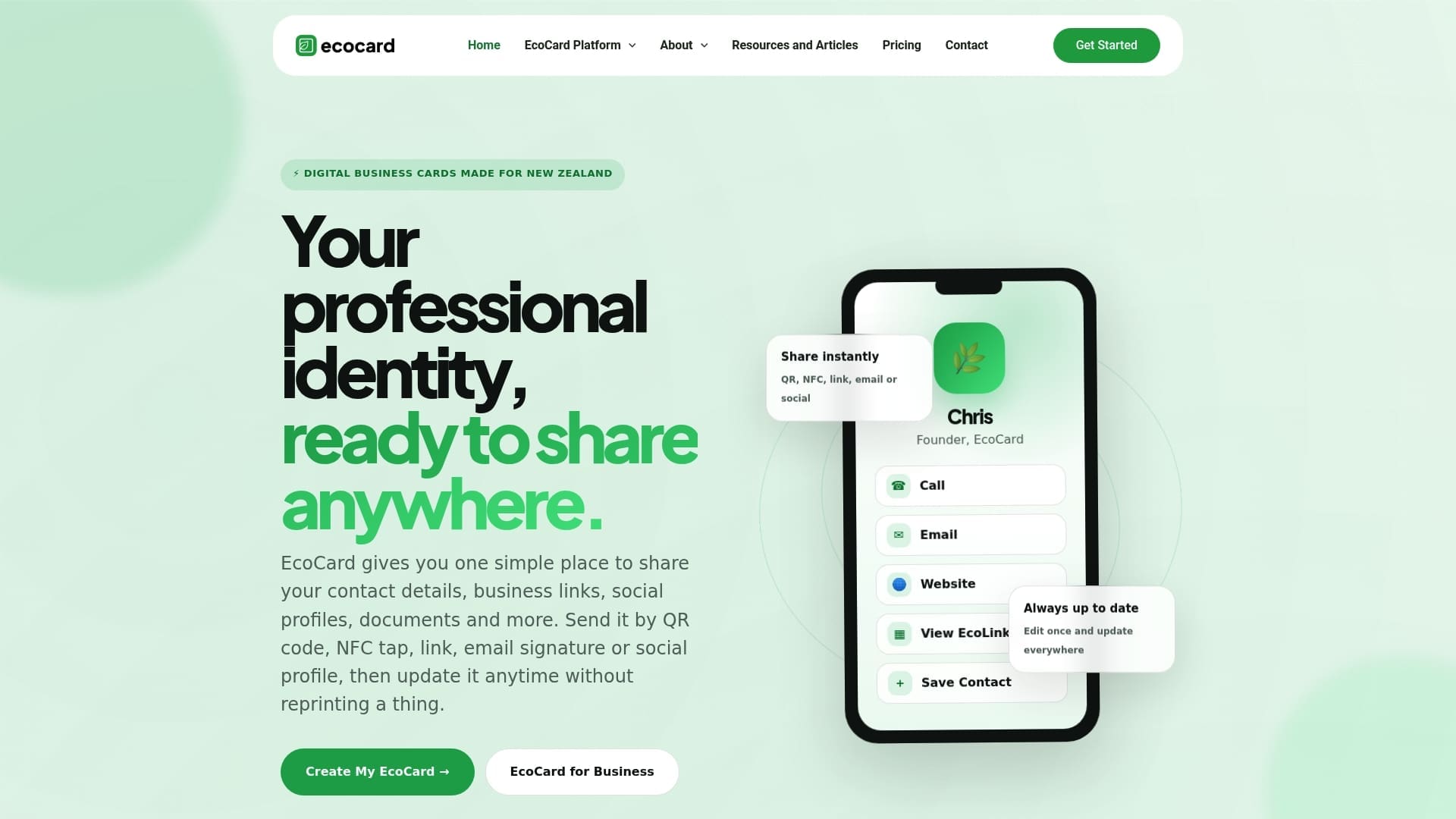
If you are weighing up per-user pricing against admin overhead, we built EcoCard around solving exactly that tension: one subscription that keeps every staff card on-brand, updates live when details change, and lets you onboard or offboard a team member in a few clicks rather than chasing individual edits. Our pricing page lists plans from Individual through to Enterprise, and our business page covers how central admin works for teams of any size.
- Start with an Individual plan at a monthly fee if you are evaluating the product solo.
- Move to higher tier plans as your headcount grows, each adding more admin and analytics features.
- Contact us about Enterprise pricing if you need custom integrations or support.
Check our pricing page to compare plans or request a demo through our business page before you commit.
FAQ
What is the typical price range for digital business card software?
Individual plans are often priced under $10 a month, while small team or business tiers typically range from $20 to $100 a month depending on headcount and admin features. Enterprise pricing usually requires a custom quote based on your specific needs.
Does GST apply to digital business card subscriptions in New Zealand?
GST at 15% applies when the service is performed, provided or received in New Zealand, and the rules differ slightly depending on whether the provider sells direct or through a marketplace, according to Inland Revenue. If your provider is non-resident and not GST-registered, you may need to self-assess GST under reverse charge rules.
Is annual billing cheaper than monthly for digital business cards?
Annual billing commonly offers a discount compared with paying monthly, though the exact amount varies by provider and should be confirmed before you sign up. Ask your provider directly what their annual discount is, since it is not always listed prominently.
What features justify paying for a business or team tier over an individual plan?
Business and team tiers typically add central admin controls, bulk onboarding and offboarding, usage analytics and consistent branding across every staff card. EcoCard’s business plans include these central management features specifically to reduce admin time for growing teams.
How much does EcoCard cost for a small business?
EcoCard’s Starter plan is $19.99 a month, Business is $49.99 a month, and Teams is $99.99 a month, with Enterprise pricing available on request, as listed on the EcoCard pricing page. Individual plans are $9.99 a month, with additional EcoCards available at $4.99 a month each.
Recommended
This article was produced with AI assistance and reviewed for accuracy. It is provided for general information only and is not professional advice.

